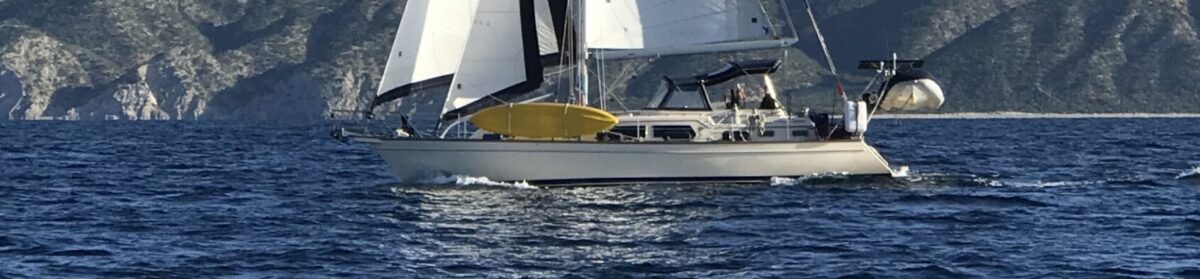
We got up fairly early, and underway by about 7:30. We had breakfast and did our devotions while we motored out of the bay. With a gorgeous morning all around.
Two hours later we were out of Bahia Concepcion. Shortly after that we started the water maker. We ran that for awhile and we sailed back and forth. Renee’ washed clothes (which takes probably 12 gallons per load). After about 4 or 5 hours, we had a noise from the water maker, and while everything looked “ok”, I shut it down and figure I really need to clean the plankton strainer, this is a pre-filter that is between the sea strainer and the two filters in the system before the high pressure pump.
So, since we were done with laundry and water-making for the day, We wanted to get to Chivato and anchor and get after the strainer.
I attempted to start the engine, and discovered that the battery for the engine start was dead. This goes to show, we are still learning the boat. We have a pretty complicated electrical system:
Three batteries:
- House bank: 750 AH made up of 6 type 31XT Lifeline AGM batteries hooked up in parallel
-
Engine start battery: 100 AH, type 27 Lifeline AGM
-
Generator start battery: 100 AH, type 27 Lifeline AGM
A variety of AC sources:
- 30 amp shore power for the “A” bus (outlets, water heater, OLD battery charger)
-
30 amp shore power for the “B” bus (Air conditioners, Washer/Dryer, Water Maker)
-
8 KW Generator that can supply both “A” & “B” buses
-
A 2500 watt inverter/115 amp battery charger that was added several years after the boat was built. This comes from the house bank of batteries, and only supplies the outlets. It is automatic, in that when you turn it on there are no other breakers to operate and it supplies the outlets only, so you can’t accidentally try to run the water maker from it, or the water heater or anything other than what gets plugged in.
A variety of battery charging sources:
- The original battery charger (which I thought was a spare, and not being used) 60 amps
-
The new battery charger: 115 amps
-
The alternator on the Engine: 100 amps
-
The alternator on the Generator: 15 amps
-
Solar panels 470 watts Kyocera 235 watts per panel & an Outback Max 60 controller. (This is the upgraded version. There is evidence on the boat that the original panels were about 230 watts with a different controller).
But the devil is in the details:
Of the three battery and associated circuits, the Generator and its start battery are the easiest to understand. There is one battery, and one way to charge it, the alternator on the generator. The loads on this battery are specific to the engine on the generator, that is the starter and the fuel pump.
Next is the Engine battery, it gets charged by the Alternator on the engine and (I thought) the 115 amp charger for the house bank. As it turns out that is not true.
The house bank, which gets charged by the 115 amp charger, and the engine alternator and the solar panels.
I thought the 60 amp charger was a spare and turned it off a couple of weeks ago, as I happened to look in the engine room when we are on shore power and the fan was running on this charger. I figured why run the fan with no other loads? So, I turned it off. This is part of the setup to get the problem.
This should not have been a problem, as the alternator on the engine should still charge the batteries, (that is the house and engine start batteries), but it was not.
So, more explanation: The alternator on a boat engine and in your car are virtually identical. In the case of your car, when you turn off the ignition, the engine stops. When the engine stops the alternator stops, part of the way this works, is that the output circuit from the alternator to the battery gets opened. If you continue to spin the alternator with out a battery attached, the output diodes in the alternator will be burned up. This is not too much of an issue in cars, as whether they are gas or diesel they pretty much turn off when you want them too. In a boat, the way it works, is you push the stop button and when the engine is stopped, you turn off the key. The turning of the key is what disconnects the battery from the alternator. Well if you push the button, but let it go before the engine comes to a complete stop, the engine will keep going, therefore continue to spin the alternator, if you turn off the key while the engine is spinning, you kill the output diodes in the alternator. There is very little (as in none) forgiveness by this system. This has happened one time since we left San Diego.
The load on the engine start battery is pretty low overall, and after a couple of weeks it was finally dead.
I was able to start the engine by turning the key, and pushing the button that connects the house bank to the engine start button (for emergency start) while pushing the start button for the engine. Now the engine is running, but the battery is still dead. This is not a great situation. I started the generator, which powers the battery charger, I expected to see battery voltage for the house bank and the engine start battery to go up. Voltage on the house bank went up (good), voltage on the engine start battery did not (bad). I thought what the heck lets turn the 60 amp charger back on and see what it does. As soon as I turned the 60 amp charger back on, engine start battery came up, I looked at the output for the 60 amp charger and it was 20+ amps. That is good and bad, When charging batteries, you should not put more than 13% of the rated amp hours in as charging current. In this case 100 AH, so 13 amps. This is a case where too much is not a good thing. Oh well, I will keep the battery charged in the future and that will limit the current going in.
Next up was working on the water-maker. When we got anchored, we were still running the generator to charge the batteries. I went to work on the plankton filter. So, to explain the water maker see if you can follow this:
From the ocean we have a pickup connection under the boat it comes in through an isolation valve followed by a strainer and then a small pump this pump delivers sea water up to to a PLANKTON filter (this is a cleanable mesh screen in a filter housing) from the Plankton filter the water goes through a 25 micron filter, then a 5 micron filter then to the high pressure pump to a pressure regulator (adjustable) then to a Reverse Osmosis membrane. The good stuff coming out of the Reverse Osmosis membrane goes to a Total Dissolved Solids (TDS) meter. Followed by a diverter valve where the output of the water maker is either directed to the tank or overboard. The bad stuff from the Reverse Osmosis membrane goes overboard. There is a pressure gauge on the inlet to the 25 micron filter to let you know when it is time to replace the filters. This gauge is a compound gauge, as in it shows both pressure and vacuum. I had not looked closely enough to recognize that it showed vacuum.
On this compound gauge, high pressure means it is time to replace the 25 and 5 micron filters. Low pressure (vacuum) means that the plankton strainer is plugged. OOPS!
Next on my list of things to do was to clean this PLANKTON strainer/filter. So, I cleared the area and got the wrench for taking the bowl off the strainer, and it would not budge. I tried a bit harder, then I got a hammer, then I put my foot into it and broke the wrench. All in all not a great way to end the day.
To summarize, the Engine alternator is dead. The water maker is out of service with a plugged plankton strainer. We have about 40 or 50 gallons (estimated) in the water tank. The gauge on the water tank is indicating 80% (260 gallons * 80%= 208 gallons).
That is enough damage for one day. Tomorrow we cross to San Carlos / Guaymas.
Oh and tomorrow is Saint Patricks Day, and we had a “virtual night out” with our beer group!
We do have room for guests, if anyone is interested in visiting and spending a week or so with us, drop us a line and we will coordinate. What you have to do/have is you need a passport and will need to be able to get to where we are when you are going to be down. When we know what time frame you are thinking about we can let you know where we expect to be so that you can make your travel arrangements.
If you want to know where we are, click this link:
https://forecast.predictwind.com/tracking/display/Make_Me_Laugh_Again

