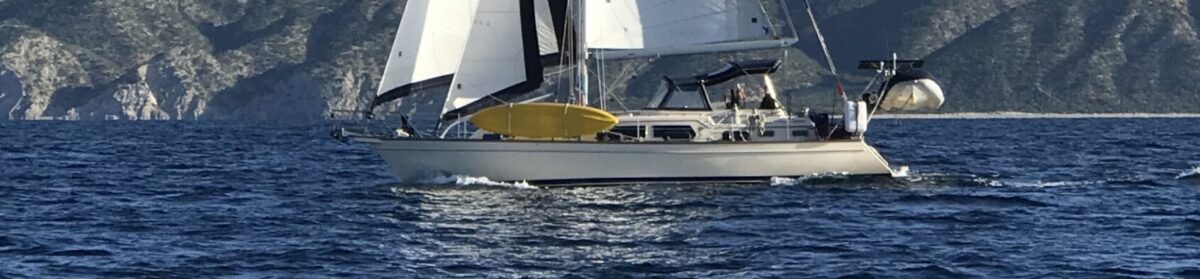
Rocks! November 28 – December 18, 2021

Let me start by saying, this is a very long post, and it is somewhat embarrassing to write. 

We are on the hard, we had ordered new sails last March, but they were late getting here. Always “just a couple more days away”. Anyway, we needed to be in Barra de Navidad on December 2nd for the Panama Posse seminars this year.

So, we finally said “put the old sails back on, and we will head out from Puerto Vallarta on November 28th”. The sail loft that is getting our new sails had our old ones and told us to only use about 1/2 of it, he marked a spot near the top on the leech to not go out any further. 

It is about 160 miles. We really don’t like doing overnight passages, so we had mapped out a couple of stops. 

The first one was at Ipala a point about 40 ish miles from La Cruz, the marina we were in. We have been there a couple of times, and it is an adequate anchorage. There are a couple of obstacles in the little bay. There are pangas (fishing boats), fish pens, (netted areas) and, oh yeah there are ROCKS. We got there mid afternoon, and set up to anchor, this means my wife takes the helm, I handle the anchor, she has two phones running the anchor alarms, and an iPad with Navionics running, so she has better detail than just the chart plotter.

I had reviewed the chart before heading forward to the anchor, but reversed the fish pens and the ROCKS in my head. We headed in and were just about to drop anchor when I saw the rocks behind me and slightly to stbd. We turned and moved away from them, but still managed to bounce a couple of times. Reneé misjudged where we were and I could not back her up from where I was.

We found a safe spot to anchor and after getting setup, I went snorkeling to see the damage. There were a couple of chips the size of silver dollars that I saw, but nothing “major” we debated continuing south to Barra de Navidad, but thought about being 160 miles from the nearest boat lift with a potential problem. So, we turned around the next day and headed back to La Cruz.

Of course there was no cell service, and the satellite phone was being finicky so we could not call ahead to the boat yards until we were in Banderas bay.  On the way north, we had the normal sailors wind, that is to say it was coming from exactly where we wanted to go, and it was way too fast. We had 35+ knots on the nose with gusts to 48 knots. Our OLD mainsail, has had issues for some time, and as I mentioned before, we could not use very much of it anyway. We had it out straight back to stabilize the boat while motoring into the wind with probably 3 to 4 foot waves. A couple of hours of this, and Reneé said something about the sail and I looked up and saw it was ripped from the leech forward about 4 feet. So, we rolled it in, and kept going. Once we rounded Cabo Corrientes things calmed down and it was relatively peaceful getting to La Cruz. We even saw a pod of whales. 

There are two yards here that could haul us out Opequimar and La Cruz. Neither could take us right away, so we headed to La Cruz as they thought they could get us this week, whereas Opequimar needed someone to leave to have room for us. 

We were scheduled to haul on Dec 1st, at 3:30 pm, we called about noon to check in. They said there was a problem with the brake on the travel lift, and they were unsure about lifting our boat.  As a side note, a friend had posted a picture from San Carlos yard on November 30 (as in the day before) of a boat getting dropped there due to a broken strap. So, we were really okay with the delay. The yard had parts coming on Saturday, and would need a few days to get back on schedule. We rented a car, coordinated with some neighbors to watch our boat and drove to Barra.

When we got back to the boat, we checked in with the yard and we were told that it would be Saturday December 12. We tried to get the old sails down, actually we tried to get the loft to take the old sails down (our new sails are here now!) but due to other work going on they were not available.

Finally, on Saturday 12/12 we got hauled out. The people doing the repair were ready, and immediately ground out the scratches and cut two holes in the bottom of the keel to let the water out, about 5 gallons. I videoed the water draining, I started about 30 seconds after it started for 7 minutes and then watched for a few more minutes. The first estimate from the repair guy after looking and before the grinding was splashing on Tuesday 12/14. Well, that didn’t happen, they have had someone with a heat-gun drying this out for two days so far.

In the meantime, today the sail loft came for the sails. Three guys at 9 am, they took down the jib, then the staysail, then started in on the main. They took a couple of hours off when the wind came up early afternoon, but 5 of them came back and worked until after 6 pm removing the old sail. I think the biggest piece might have been 10 square feet. It didn’t come out of the mast easy. Most of the time one of the guys was up the mast pulling bits and pieces of the sail out. 

Right now, the boat is in the yard, we have no sails (yet), the keel is open and draining/drying and we have shore power. 

I communicated with Bill Bolin (previous exec at Island Packet) about how much water was in the keel:

My question to him:


Hello, we bumped our keel on some rocks here in Mexico. We got hauled out about 2 weeks later and when they ground down the two worst areas they cut into the keel and water gushed out. Probably on the order of 5 gallons or so. The water was clear, and did not slow to a trickle till it had been running for about 10 minutes. (I have 7 minutes of video and missed the first 30 seconds and it was several more minutes before it stopped). 

My question is, about this void, is it supposed to be there, or do I have another issue to look for? 

IP 445-11.

Thank you for your time

His response:

Neil, sorry to hear that happened!  there is typically a gap between the sides of the ballast material and the molded keel. I suspect on a 445 that might equate to 5 to 10 gallons of space for water to get into. That water would’ve been pressurized coming into the bottom of the keel and would find its way into any nook and cranny.  Just need to let it dry out a bit, don’t think you need to force Erin “air in” or anything else. And make a glass repair as appropriate.


Bottom line, the boat is safe, the damage to the keel is repairable, the new sails are here and will be put up when we are back in the water, our pride, well it goes before a fall anyway, so it will recover.

Today (Saturday 11/18/2021), they applied the resin and fiberglass repair to the keel, and we have a tentatively scheduled splash date of tomorrow. We will get some touch up to the bottom paint as well. I have spoken with Mike (the sail guy) and our sails should be on the boat prior to splashing the boat, and will be put up on Monday. He only has workers until 2 tomorrow (Saturday) and the wind comes up in the afternoon. So, next week we should have sails, and the repairs done on the keel. Only issues left are maintenance/normal repairs that have to be done because it is a boat!

On Saturday, the final touch up of the bottom paint was applied and we splashed at 1 pm right on schedule. Total costs for this repair was:

$900 for the work,

$1148 for the Yard

$490 for the inn

About $37 per night in the marina, figure at least a week more than if we had been able to stay in the anchorage. So at least another $300.

So, ball park of about $3,000 for this repair. 

Our boat getting set on the hard for the keel work.
A view of how bad the damage was from the rocks, there were a couple of scratches on the the other side as well.
This was taken a day or so later, note the wet spot under the hole, it was still dripping.
1st layer of fiberglass
2nd layer of fiberglass
1st layer of fiberglass on the other side
2nd layer of fiberglass on the other side
Primer on worst side
Primer on the other side
Bottom paint over primer, can’t even tell it was repaired.
Bottom paint on the other side
Headed back into the water.

Water heater story

First let me point out that many of these pictures have been posted elsewhere in this blog, and that the final replacement happened on 10/30/2021. This is a more complete explanation of what was involved.

Our water heater has been leaking on and off for “a while” When we bought the boat there were indications of a leak at the base of the water heater, but no standing water (earliest reference I have for the leak is late January 2020. Yes, that is 23 months ago. Sometimes it would leak and be a pain for days or weeks, and sometimes for weeks or months it would not leak. It is very hard to find an intermittent leak. Eventually we decided to just go ahead and replace the heater. This is far easier said than done. As a reminder we are in Mexico, so first up is the issue of figuring out where to buy the heater, then how to get the heater here, then how to get the old one out and the new one in. So, in no particular order here are the questions and answers:

How to remove/install the heater. I asked Island Packet how to do this, from the pictures, you will note that the heater will not fit through the access to the heater. Island Packet (who made the boat) said that the heater was installed after the internal fiberglass was installed, and that it went through the back of the settee and slid down the hull to the correct level, then was moved to the centerline and bolted down. Sounds good, but the pictures show that there are now three refrigeration compressors located here. All installed after the water heater and before the boat left the factory. In other words this is an issue on all of these boats. So, comparing notes with other IP445/465 owners, at least one has cut his settee and removed/replaced the heater and then repaired the settee (Jim Shanahan on an IP 445-14 S/V Watermark III) I got pictures and suggestions from him. I asked Island Packet about which way they would go, cut the settee or remove all the refrigeration? They responded with, cut the settee.

Where to buy the water heater, I searched on line and finally bought it on Amazon and had it shipped to our son in Sacramento Jan 25th, 2021. We paid about $485 for the heater.

How to get it to the boat. We brought it to Mazatlan as “checked luggage”. When we got there we had to pay 19% import duty on it. But at least we had it on the boat. Oh and by the way when we got back the “intermittent” leak was not leaking.

Somewhere in here, I figured out that we needed to get an anode for the heater (this is a small metal piece that is designed to erode faster than the internals of the heater and be replaceable). It screws into the heater where the drain valve is. So, I ordered one and brought it down a month ago.

Finally HOW to actually remove/install this heater. We asked Elizabeth (she runs the company who watched our boat through the hurricane season). She gave us the connection to Sergio who brought a fiberglass guy who spent several hours cutting the old settee out, then he left and another guy showed up to help Segio with the plumbing work. The fiberglass guy was supposed to be back on Monday, then Tuesday and finally he showed up on Wednesday. This sounds pretty bad, but in all reality it probably had more to do with language barriers than anything else. We are in Mexico, and they celebrate the Day of the Dead, this is an important holiday here, and it involves a 4 day weekend. Saturday – Tuesday, and the Monday and Tuesday we were expecting him to show up were part of the 4 day weekend. In any case the finished product works great and looks fine.

OH, and now that the old heater is out we can see what the problem was, the plumbing system on the boat is hoses, and the supply hose to the heater was clamped onto a plastic nipple (cracked), screwed into an iron elbow which was screwed into a brass fitting screwed into the aluminum tank. At this point we had a new heater on board, and all required parts to install it. So the old heater was removed and the new one installed.

THE WATER HEATER IS A WHALE/SEAWARD MODEL F1100. THE F MEANS THE ENGINE HEATER HOSES GO TO THE FRONT OF THE HEATER. THE 11 MEANS 11 GALLONS. THE 00 MEANS IT IS 120 VOLTS (IF IT WAS S1150 IT WOULD MEAN THAT THE HEATER HOSES GO IN THE OPPOSITE SIDE FROM THE FRONT, IT IS STILL 11 GALLONS, BUT IT IS A 240 VOLT HEATER.

Measurements to cut
Measurements to cut
The piece that was cut out headed to the shop to make it into a piece that can be installed and removed for the next time.
The old water heater coming out.
The hole with the water in it.
The old water heater, note the top right fitting is broken. This is what was leaking. As you might be able to see, we have a hose connected to a plastic fitting screwed into an iron elbow, screwed into a brass fitting, which is screwed into an aluminum tank. Oh, and there is no anode in the tank.
This is the new heater installed. The cover will get put in on Tuesday.
This is the finished settee.


Last night in San Diego

It has been a very busy last couple of months. We have done a lot of repair and updating.

One of the upgrades was installing an Iridium Go! This is a satellite communications device. One of the features is tracking. It will update on an hourly basis. The track stays for 9 months.

Here is the address:

https://forecast.predictwind.com/tracking/display/Make_Me_Laugh_Again

We have some good friends down on our boat, Tom and Cynthia Corelis, Bob and Sharlene Miller (who are going with us) and our son Nate.

We got a lot done today, we finished selling our car, switched our cell phone provider, got diesel, filled the water tank, emptied the holding tank, washed the boat, changed the engine oil, & put a bunch of stuff away.

At this point, we believe we are ready to go in the morning.

6 months of preparation

We have been at Sun Harbor Marina, in America’s Cup Harbor, since mid April. The boat came with everything but everything didn’t work. It turned out to be a bigger project than we expected. We were at boat stores everyday, had workmen on the boat frequently, and our budget was thrown out the window. This is out dream so there was no turning back. Our goal of having the boat complete and ready to go on 10/1 (still planning a departure date of 11/1) failed when we took a shakedown cruise up to Monterrey from mid-August to mid-September (close to 1000 mi round trip). On that trip we found that the boat can handle rough seas better than we can. We also found much more work to do. So…here it is the end of October and work is still being done. The end is in sight and we still plan on leaving for Mexico on 10/30 with friends, Bob and Sharlene.

We bought our boat!

Our boat is a 2005 Island Packet 445, previously named Tan Tori, and before that Second Wind.

Specs

Keel: Full

Hull Shape: Monohull


Dimensions

  • LOA: 53 ft 1 in
  • Beam: 14 ft 4 in
  • LWL: 38 ft 1 in
  • Maximum Draft: 5 ft 0 in
  • Displacement: 32000 lbs
  • Ballast: 12800 lbs
  • Headroom: 6 ft 6 in
  • Dry Weight: 32000 lbs


Engine

  • Total Power: 75 HP
  • Engine Brand: Yanmar
  • Year Built: 2005
  • Engine Type: Inboard
  • Engine/Fuel Type: Diesel
  • Engine Hours: 1879
  • Propeller: 3 blade propeller
  • Drive Type: Direct Drive
  • Engine Power: 75 HP


Tanks

  • Fresh Water Tanks: 1 (260 Gallons)
  • Fuel Tanks: 1 (160 Gallons)
  • Holding Tank: 1 (55 Gallons)


Accommodations

  • Number of single berths: 7
  • Number of heads: 2


Manufacturer Provided Description

The center cockpit 445 possesses all the exemplary qualities that have earned Island Packet a worldwide reputation as the leader of cruising boat design and construction. Naval architect Bob Johnson and the Island Packet design team have created the 445 by combining the superior comfort, ease of use, seakeeping, and safety attributes that are the hallmark of every Island Packet, along with innovative new features and stunning good looks that will further reinforce Island Packet’s position as America’s Cruising Yacht Leader. Tankage and storage on the 445 is exceptional. All tanks are centrally located below the cabin sole, benefiting stability and interior storage space elsewhere in the yacht with minimal effect on trim. Every detail, from the geared rack and pinion steering system to the swedged and threaded fuel hose fittings, is carefully chosen for its important contribution to long term quality and reliability. Numerous details like magnetic reed bilge pump switches and thru-bolts with lock nuts on both seacocks and prop shaft couplings typify the approach to building every aspect of an Island Packet. Heavy duty, high output alternators with Digital Duo-Charge controllers, premium pre-tinned wiring, and large capacity absorbed glass mat (AGM) batteries reflect the many quality features built into the 445 that help ensure the owner years of comfortable, trouble-free cruising.


Staterooms


Located aft, you are welcomed by a wide double island berth surrounded by a solid teak and oak sole, plenty of cabinets, lockers, drawers and shelves. End of bunk lifts on gas support struts to reveal large blanket tray over large cedar-lined drawer. Extra-height rods are provided outboard in the hanging locker for longer items. A plush dressing chair, vanity mirror and drawer just forward of the berth add extra convenience. A door in the aft bulkhead provides interior access to the lazarette storage. Chrome plated cabin sidelights with individual dimmers. Overhead lights with remote dimmer switch. Five opening ports, a large central overhead hatch with screen and shade and two Dorade vents make these owner’s quarters particularly bright and freshly ventilated.


Located forward features private access to the adjacent head. It includes a large double island berth, plenty of lockers, cabinets, drawers, and shelves suitable for extended stays onboard. The berth top hinges on gas support struts to reveal a blanket tray underneath. Several ports and an overhead hatch with screen and shade and two dorade vents provide ample light and ventilation.


GUEST HEAD


The ensuite aft head, as well as the forward head, features a vanity with a Corian counter top, separated shower stall with folding acrylic door and molded seat. A standard VacuFlush electric flush head with a curved backrest for secure and comfortable seating. Two opening ports, one overhead hatch with Peek-A-Boo blinds.


Galley


The gourmet galley includes opening ports on either side to keep bright and provide air flow. The top-loading refrigerator and freezer, with digitally controlled cooling units, provide generous cold storage. A pull-out refrigerated drawer is also included for quick access to popular beverages/food or for fruits and vegetables. The galley also has  built-in dish racks, cutlery drawers, deep double sinks, a slide out trash bin, a microwave oven and abundant cabinet and locker storage. Other enhancements include Corian counter surfaces with integral sea rails, a Force 10 LPG range/oven and a water purifying system serving all interior cold water sink taps


Electrical


  • MasPower 8Kw generator 684 hrs
  • Prosine inverter
  • Balmar 100 amp alternator
  • Charles 5000 series 60amp 3 stage battery charger
  • Solar panels and controller
  • (8) AGM 12 volt batteries: 6 house, 1 dedicated engine start, 1 generator
  • UL approved marine Pre-tinned 600V wiring throughout
  • Dual A-C dockside power systems w/(1) 50′ shore power cord
  • Bilge alarm


Engine

  • 75 hp Yanmar turbo diesel
  • Muir Cheetah 2500 anchor windlass
  • 6HP SidePower bow thruster
  • Lewmar Mamba direct drive, geared steering system


Electronics


Adjacent to the companionway in its own spacious alcove, this area features a high backed swivel armchair, an inlaid chart table with storage tray. A hinged storage area aft of the seat neatly stows charts and all master electrical panels for shipboard AC and DC equipment are within easy reach. A hanging locker suitable for wet gear is also provided adjacent to the companionway.


  • (2) Raymarine E-120 12″ color LCD multi display units
  • Raymarine Raystar 125 GPS sensor
  • Raymarine 4Kw radome
  • Raymarine ST6002+ Autopilot
  • Raymarine ST60 knot/depth/wind
  • Pactor 3 modem
  • External hi-power Wifi system with marine antenna, mount and wireless access point
  • AIS
  • Lewmar Mamba autopilot drive
  • ICOM M-802 SSB transceiver
  • ICOM M-602 VHF radioSony MEX-R5 Marine AM/FM/CD/DVD
  • KVH TracVision G4 18″ SAt TV w/gyro trac
  • DirecTV HD receiver
  • Sharp AQUOS LCD TV 26″
  • Sharp AQUOS LCD TV 20


other


  • Air conditioning and heat
  • Ultraleather fabric
  • Vacuflush heads
  • Corian countertops
  • Hella fans
  • Splendid C6200 washer/dryer unit
  • (15) opening ports with screens and shades
  • (6) deck hatches with screens and shades
  • (4) dorade style vents with screens
  • watermaker HRO Safari Escape
  • Epirb


Deck and Hull


The exclusive Full Foil Keel provides a combination of strength, stability, seaworthiness, moderate draft, and passage making performance. SeaSafe anchor rollers provide fully captive low chafe guides for chain and rode while a foredeck hatch provides access to a large chain locker. A recesses foredeck with bulwarks, uncluttered side decks and full length cabin top handrails provide safe footing and security on deck. The broad transom platform with integrally molded steps and concealed swim ladder makes this a gracious entryway or lounging area. The ergonomically designed cockpit provides comfortable seating.


  • Custom radar arch by Thomas Marine equipped w/dinghy & outboard lift
  • Dodger and bimini w/connector piece – Sunbrella
  • Hatch, winch, & windlass covers
  • Wheel cover & sheet bags
  • 88 Lb Rocna anchor w/300′ 7/16″ high test chain
  • 44Lb Claw anchor w/ 30′ 3/8″ G70 chain and 250′ rode
  • Anchor washdown
  • Deck lights
  • Cockpit cushions – 2″ closed cell foam w/ Textaline covers
  • Welded s/s mast rails
  • Double s/s bow & stern rails
  • Teak caprail with s/s striker
  • Stainless steel destroyer style wheel
  • Hinged cockpit table
  • Gelcoat – PolyClad3 (10 year limited warranty)
  • Deck cored w/PolyCore (10 year limited warranty)
  • Docklines
  • USCG safety package


Sails and Rigging


The generous cutter sail plan, couple with the convenience of all major control lines led aft tot the cockpit, delivers spirited, safe, and easy cruising for short handed watches or large family outings. Roller furling systems on all sails add convenience, while the patented Hot Boom equipped stay sail adds considerable performance and provides superb adaptability to a wide range of sailing conditions. The 445 is the only yacht in her class to offer this self-tacking, self-vanging stay sail design. There are 3 electric winches in the sailing cockpit


  • main -in mast Furling Quantum
  • Genoa-110% -Quantum
  • Asymmetrical spinnaker 08
  • Lewmar 44 cst electric winch
  • Lewmar30 CST 2spd winch – main
  • Lewmar 30CST @ spd- Genoa
  • 2 Lewmar 54’s 2spd CST elec – Sheets
  • 2Lewmar 16 CST- secondary
  • Lewmar 44 CST winch
  • Sail Area Cutter Rig is 1074 square feet.


ACCOMMODATIONS


Solid teak hardwoods are evident throughout the finely crafted interior. The light and spacious salon features full-length settees port and starboard. The port settee extends to the centerline to make a double berth. The salon table can be stowed against the forward bulkhead or folded out for entertaining. Behind the table is a wine rack/shelves. Large windows surround the salon providing panoramic views.  Lighting is abundant throughout the interior. Recessed lights and numerous, well-placed halogen reading lamps, all with dimmer switches, illuminate the area.


Adjacent to the companionway is a navigation center sure to make any sailor proud! It features a high-backed swivel armchair, an inlaid chart table with storage tray, cabinetry space sufficient to mount a wide variety of electronic equipment and access to the electrical panels for shipboard AC and DC equipment. There is a large wet locker located close by as well.


The gourmet galley includes opening ports on either side to keep bright and provide air flow. The top-loading refrigerator and freezer, with digitally controlled cooling units, provide generous cold storage. A pull-out refrigerated drawer is also included for quick access to popular beverages/food or for fruits and vegetables. The galley also has  built-in dish racks, cutlery drawers, deep double sinks, a slide out trash bin, a microwave oven and abundant cabinet and locker storage. Other enhancements include Corian counter surfaces with integral sea rails, a Force 10 LPG range/oven and a water purifying system serving all interior cold water sink taps.


There are 2 large staterooms perfect for living aboard or world cruising. Both offer exceptional amenities including island berths and ensuite heads. The aft stateroom features plenty of hanging storage with extra height provided by the outboard hanging locker. Access to the aft lazarette storage area is available through the aft bulkhead. Both staterooms include numerous opening ports, large overhead hatches and deck vents, providing plenty of light and ventilation. Both berths are surrounded by an array of cabinets, lockers, drawers and shelves, and include a large panel that lifts on gas support struts to reveal a blanket storage area.


Both heads feature vanities with Corian countertops, separate shower stalls with folding acrylic doors and VacuFlush electric heads. Directly across from the forward head door is a large hanging locker