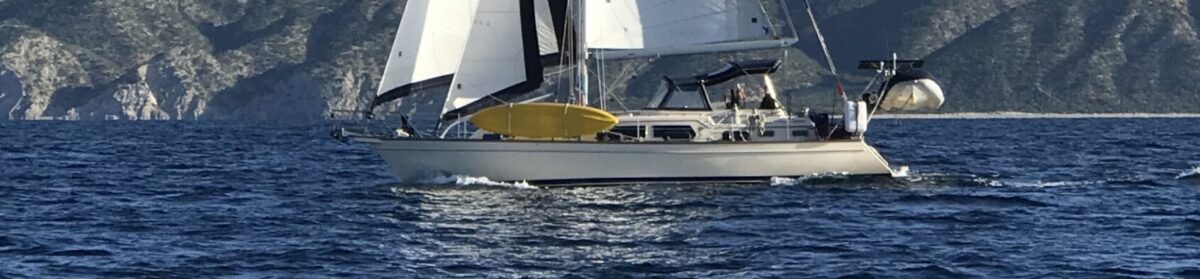
We got back to the boat on October 25th with plans to be underway by November 9th. Well LIFE is what happens when you have plans.
We arrived on Sunday night, but had told Salvador Cabrales III the guy who is running the yard (Cabrales Boat Yard, Puerto Peñasco, Sonora Mexico), son of the previous owner/runner of etc. I believe it was his idea to start doing cruisers yachts in 2013. They hauled more than 100 boats this year, and still had room for more. They used to do nothing but shrimpers boats. While Salvador was not at they yard when we got there (busy delivering a sailboat to the Pacific North West) he left instructions to get our boat unwrapped and a ladder set up for us.
Monday morning we got on the boat and started checking things out. Engine Start battery (12.5 volts Good), Generator Start Battery (12.5 volts Good), then the House bank, (3.2 volts, VERY Bad!). Well, sometimes it goes that way. To put things in perspective, the Engine and Generator Start batteries are AGM (Advanced Glass Mat) which means no maintenance, and they were new in 2017. They are Lifeline type 27 batteries, (100 amp hours each) this is a very good brand of batteries and it is good they were Okay. The house bank were Lifeline type 31XT, with 125 amp hours each and there are 6 of them, so a total of 750 Amp Hours of capacity. These batteries were new in 2014, so at 6 years old and were nearing the end of their life, but we were still hoping to get another year or two out of them. Oh well, that was not to be.
Now I had to figure out how to replace the house bank of batteries, while in Mexico on a short time schedule. I had a couple of options:
- Replace them with Lifeline type 31XT (same as was in their before) upside, easy swap, downside I really wanted to replace with LiFePO4 (lithium) batteries in a year or two. (Lifeline batteries $404 each times 6 = $2,400)
- Replace them with LiFePO4, and upgrade what ever needs to be changed out at the same time, make the various adjustments to what ever does not get swapped out and deal with the shipping issues. This required figuring out which batteries I could get quickly, what equipment I needed and how to get it to the boat.
- Because of the short lead time, I was down to two suppliers, Battleborn and Victron Energy (which uses Relion batteries). These two are probably among the highest price for LiFePO4 batteries anywhere. ($874 each times 6 = $5,244 for the batteries alone). Victron Energy was slightly lower, but said they had to charge taxes, Battleborn said no tax as it was a solar installation. I got a specification list of what I need to change, this took quite a bit of time on the phone with, Magum Energy (manufacturer of our current inverter/charger) who said I needed a firmware upgrade and new remote display and gave me a contact in Arizona to price it (approximately $500). Outback who makes our solar controller, who said all I needed to do was change some settings. Balmar who makes our engine alternator external regulator (EXCELLENT SERVICE!!!) who also said all I needed to do was change some settings. Then Victron Energy (who every where I have looked is the “best” for LiFePO4 battery charging) to find out what a new charger/inverter would cost. So, $500 for two new parts for the old inverter/charger or $1000 for a new charger at 3000 watts/120 amps vs a 10 year old 2000 watt/100 amp charger.
- At the end of the day, the price buying the equipment and batteries from Battleborn or Victron including shipping/tax and the equipment was within about $100. The total price with everything was about $7.500 (about 3 times the AGM batteries, more on this later). The biggest difference between the two was Battleborn promised delivery by the following Monday. So, I went with Battleborn.
- A comparison of the two types of batteries is important for this discussion regarding why the price difference. AGM batteries, like any lead acid battery can only be discharged to about 50% of it’s rated capacity without causing permanent damage, so our 750 amp hour bank was actually only 375 amp hours available. With LiFePO4, most places I have read say don’t go below 80% discharge, so our 600 amp hour bank has at least 480 amp hours available (Battleborn actually said we could go to 0% without damage, I don’t plan to go that low). Other issues with AGM is that they have 3 different charge modes, Equalization, infrequently used to refresh the batteries), Bulk which means lots of amps up to 80-90% of capacity, then absorption at a very low current to finish this off. We were typically discharging our bank to approximately 70% per day, which meant that we were using the solar panels and charging system to recharge the batteries from that point up to a little bit better than 80% by the end of the day, then we were running the generator to finish the charge every night, with almost no load on the generator. LiFePO4 batteries on the other hand have two charge modes Bulk from 0% up to about 99% with the limit being about 1/2 amp per amp hour of capacity, so we have a “limit” of about 300 amps charging all the way to the top. The last 1% of capacity is a balancing phase and takes less than 10 minutes. So, if our bank is completely discharged we have three types of charging working together to charge the bank, 120 amp hours from our new charger, 60 amps from our solar panels, and 100 amps from the alternator on the engine, for a total of 280 amps going in to the bank, a bit more than 2 hours from completely discharged to fully charged. This assumes we are running the generator and the engine in the middle of the day to charge the batteries. The summary of the differences between AGM and Lithium is that you get more Amp Hours for the size of battery, and they last three to five times as long, so in the long run they will probably be the last batteries I ever buy for our house bank and will be less expensive overall then the AGM’s.
- The solar charging system has it’s limitations especially with AGM batteries. Since they can only take the bulk current up to 80 – 90%, the house bank was typically there by 10 or 11 am, then even though the sun is shining, the batteries won’t take the current. Lithium does not have that issue.
So, we put our order in and waited. Not delivered on Monday, I called on Tuesday, and again on Wednesday and finally on Thursday got through. “Oh didn’t you get the email? Our order was late…. So, we are late etc. anyway, about a week later all of it was ready to pick up in Casa Grande Arizona. A cruiser we met here (Mike Gingerich) keeps an apartment in Casa Grande that he stays in once in a while, and keeps stuff there. He gave me a ride to go get the batteries and do a bunch of shopping for several people, then pick stuff up at the Gastrack in Lukeville (at the border) What a racket! Every package that gets delivered here costs $12, so if you get something big that comes in 4 packages, the cost is $12 times 4 or $60, Oh, if you don’t pick it up within a week you get to pay again, etc.
Anyway, we made the trip and drove up on Saturday and back on Sunday (Nov 7 and 8). I found another cruiser here who is an electrician, and got him to help install the batteries (Ok, he installed the batteries and I looked stuff up to help, and I paid him for his time). We both expected this to be a fairly simple process, but oh yeah it is on a boat… 4 solid days to get the physical stuff installed. Then when it was all done, except the cleanup, about an hour after he left, all the DC turned off. I was just done and left the boat. Later the next day Sunday 11/15, I found the problem, one of the wires that connects the battery bank together had a lug on the end that popped off. This was originally crimped when the boat was new, in 2005, and it lasted this long. Anyway, with Andrew’s help it was fixed in short order.
The only thing not perfect with regards to the install was one of the old wires would not work on the new bank, so when we got the bank put together the first time, we used the wire we had and lugs we found in town to make it, with plans to fix it later. This was a 10” piece of 4/0 marine grade wire with crimped on lugs on the ends. All we had was some regular 2/0 wire and some “mediocre lugs” from the electric shop here in Mexico. I managed to find a place in Arizona called Custom Battery Cables, as it happened Mike was in Phoenix picking up his lady friend at the airport and planned to take her on a sight seeing trip around the outskirts of Phoenix, right through Apache Junction and yes he could pick up my new battery cable. From time of making the call, to him picking up the finished custom cable was about 2 hours! And when I had it in hand it was installed in about 15 minutes.
Finally, the battery work was done and no longer delaying launching the boat!
Another thing we wanted done was to get our anchor and chain re-galvanized. This required sending the anchor and chain out to get this done. The first place we were told about had gone out of business, so, we did not think it would happen. While we were in the states, we heard that it was going to get done, and there were about six people who wanted either chain or anchors or both done. In any case ours did not get back until about Monday 11/9. Our anchor weighs 88 lbs, and the chain weighs almost 700 lbs. So, even though it was there, it was on the ground, and the boat was on jack stands, so the bow was about 10 or 12 feet up in the air. This had to wait until we got the batteries in so we could use the anchor windlass to pull it back up. It finally got back on board about noon on Thursday 11/19.
In the meantime, the other big project we had going on was getting the lifelines around the boat replaced with stainless steel tubing, this includes a rack on the starboard rear for a propane tank for the BBQ, two racks port rear for Diesel Jerry cans, and two for Gas Jerry cans (for the outboard for the dinghy), and six racks at the bow (three per side) for the fenders. This allows us to keep the decks clear for walking around as needed. We originally planned to do this in June when we got here, but the welder could not get the material, so it was delayed until we got back. It finally got finished on Tuesday 11/17, and since everything was now complete, we launched the boat on Thursday 11/19, we had to wait for high tide at 4:30 in the afternoon. Only 10 days behind “schedule”.
Now that the boat was back in the water there was still a few things I wanted to get done, evaluate changing the impellers for the sea water pumps for both the engine and the generator, change the fuel filter for both and adjust the regulator for the alternator, which looked like it needed to have the engine running to adjust it.
Anyway, everything got done and it looked like we could take off on Saturday 11/21. But, we missed the tide and that is a big deal here as the tide swings can be as much as 22 feet, and if you miss the high tide you can’t get out. So, we left on Sunday morning 11/22. Four weeks to the day from when we got here.
We met some great people in Puerto Peñasco, Ray Wood and his wife Chicgaila. He has had to give up sailing, and his boat is up for sail (he was helping someone with their boat last June when we were here and got under the bowsprit, and got hit in head, a bunch to of stitches and therapy later and his neck is too fragile to keep sailing. There are other reasons as well, but it puts the end to their world traveling. Mike Gingrich as mentioned above, was a great help getting around with his truck. We walked almost every morning with Mike and Ray. The Kelly family, they are parents plus four kids and are missionaries, living on a catamaran, the youngest are twins and have never known living anywhere besides on a boat. Jean Mondeau a sailor who has an older boat, and every spare part and too you can think of on that boat (a 30,000 pound crimper for wire) and spare 2/0 wire as a couple of examples). And many others. We will miss everyone there, as we are planning on getting to the south end of Mexico by next May.
We made it to church here in Puerto Peñasco for at least 3 of Sunday’s we were here. The service was bilingual, and was very well done. Since we will be back on the boat for the next several months, we will be listening to sermons via the internet from North Coast church in Vista, and Stonebridge church in Cedar Rapids, and working through the Bible in a year here on the boat.
We lived in an apartment for the first two weeks we were here, that was the same one we lived in when we were here in June. Good, a very nice place, Bad, pretty expensive. The second place we lived in was not nearly as nice, and had a steel cage door to lock when we were not home or if we felt unsafe. Good low price, Bad, the cops came at 3 am one day looking for “Victor and Daniella”, and the next day someone else came looking for “Victor”. But we felt we could not live on the boat until the batteries were back in place and working. This kept the refrigerator, the water pump, the toilets and the lights from working. Also, a huge mess in the salon.
I had a pretty big list of things I was going to do here while the stainless work was being done, but, as there really wasn’t anyone else to coordinate or do the battery work, that took all my time.
So, to summarize what got done while we were in Puerto Peñasco, new batteries, new inverter/charger, stainless steel rails, etc. our satellite phone got turned on, Sirius XM moved from our truck to our boat, the bottom of the boat got cleaned, the sacrificial anodes (zincs) got replaced. The stanchions that hold up the lifeline rails had their bolts replaced. The bottom paint got touched up. We cleaned the boat inside and out, Sunbrella material was used to make covers for the jerry cans, the propane tank, and our wagon cloth was redone in it as well. The cushions in the cockpit were replaced, the seat at the Nav station was repaired.
We lugged 50 gallons of diesel in Jerry cans and 13 gallons of gas down to the boat, as the fuel dock here was out of fuel and has been since March (Covid). A fan got replaced inside the boat, and all the stainless steel got polished. All the covers on deck got washed. Renee’ got a bunch of pictures up on the walls, and some coat racks were installed inside the boat. We found some really good restaurants for food here in Puerto Peñasco, and got the boat restocked for the season. Oh, and we walked about 10,000 steps each every day, Renee’ hit over 20,000 steps on a couple of days.
I attempted to fix some hatchs on deck, they have a riveted part that I have tried three times to fix, I have looked on line for videos on how to do this, and finally sent an email to the company asking what I was doing wrong. They said: “You are not doing anything wrong, this is an issue that has a solution. It’s hard to re-rivet them once installed, we recommend tapping the lower frame and using ss machine screws.” Well, at least I know how to fix it now.


