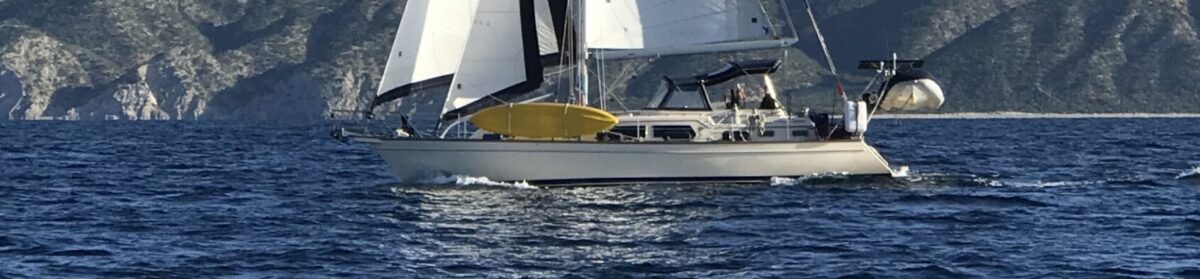
(posted 04/06/24)
Up at 6, morning routines, then up anchor and underway by 0645. It was not a good night for sleep for Reneé, a pelican (very large) decided our swim step was a great perch for him. Reneé was up several times to chase him off, at least once he got up on deck and spread his wings (at least a 5 foot wingspan). She blocked his access from the swim step and finally got some sleep. In the morning we found the stuff he left behind. I washed it off with our anchor wash down hose, (saltwater).
We motored up and figured out that some of the values on the instruments “blink” it turns out that our speed sensor is the culprit, and since we updated everything else it is not “really” compatible, even though it sort of works. The new sensor is about $400. Easy to install, but more money. Wind speed was up in the high teens and we were not looking forward to trying to get into a slip. As we were approaching the marina, we checked the weather and while it was supposed to be pretty windy, there was a predicted drop in wind from about 1 to 3 pm. We arrived at 1, the wind was down to about 8 knots (from about 22), and we backed all the way down and into slip 1, probably the hardest slip to back into in the marina. Once we were in the marina, we got shore power on and found out NO water available, so we ordered some drinking water, and gave up on the idea of washing the boat (perhaps a sponge bath?). Dinner was Chinese at the top of the hill, after a stop at tap room for a game of Qwirkle. We chatted with Ralph from SV Amnesty. Laundry was easy, a lady came to the marine and picked it up and then dropped it off. Price was lower than the laundry at the top of town, and cheaper than using the machines here in the marina. (Pretty much a no brainer as to how to get laundry done).


Hi Neil, just curious, if you have time. What was the driving need to do a major electronics replacement? I doesn’t seem like the original equipment would be that old. I did that drive from Cabo to the US, 30 years ago. Sounds like things haven’t changed a lot, still don’t drive at night in Baja. Replaced a Ford 460 head gasket out in the desert on the way to Gero Negro. Best of luck in your future travels.
While the 19 year old electronics could be made to work, it was really getting old dealing with the same but different problems with it everytime we got back to the boat. Issues we have dealt with over the last three years:
1. two of the screens died – I had 3 12″ chart plotters, and the screens did not die at the same time, when the first one went out I bought the spare on ebay, and found the only dealer in the country (perhaps the world?) that would replace the screen and convert the backlight to LED. So, when the second one died, the spare went in there and we hauled the dead one back to the states and shipped it to Miami. They take about a month to turn it around and get it back to where ever we have it shipped, so from the time we take it off the boat until it is back as a spare is 4 to 6 months.
2. Network issues have interrupted all inputs at various times, usually the temperature and speed through the water. The sensor was not bad, just a fault in the network.
3. The wind speed sensor failed (that will not change, as we are using the same instrument).
4. This time when we got back to the boat, the following were not working, boat speed through the water, wind speed (apparent and true) water temperature, the auto pilot, complete with an alarm ever few minutes related to the network issue. The GPS on the chart plotter was “mostly” ok.
Fixes in the past have been successful for a short period of time, one technician found a terminal strip splice in the sea talk network behind the AC power panel (not near any other navigation instruments) that had broken wires that turned out to be the majority of the problem with the speed through the water (of the 5 conductors 4 were broken).
This time it appears that one of the replace wires had a short in it, this was apparently the wire from the GPS antenna to the network. When it was unplugged most everything worked again. Except the GPS signal was now coming in from some other channel and it was not consistent, which meant that every couple of minutes the auto pilot died.
Other issues, the network was SEA TALK which predates NEMA 0183, and NEMA 2000. Which means the instruments and the technicians are getting older and harder to find. Since it is SEA TALK, it uses two different kinds of connectors the first is a curved three pin plug which is fairly water tight, and generally was not part of the problem. The other was spade connectors that are 1/8″ Which I was unable to find in any online electronics part system (probably cause I did not search for the correct thing). Only after we got the new system did I find out that Ray Marine sells them 11 to a pack for $12 plus shipping and handling. These are NOT weather proof, and in my case there were about 15 of these little things on the back of the instruments at the Gangway (depth, speed and wind instruments). Since they were exposed to some spray and salt air, the wires had corroded up inside the insulation.
So, one option I had was to send the last 12″ chart plotter (my spare) in for a new screen, and replace my Sea Talk Network and sensor cables (rewire the boat). Downside is that getting spare parts is getting more difficult, and when done, I would have done all the work that would have allowed replacing everything with a new updated system.
The option I chose was to replace everything with new updated NEMA 2000 equipment.
I am sorry this reply is late in getting posted, I did not see it until tonight.