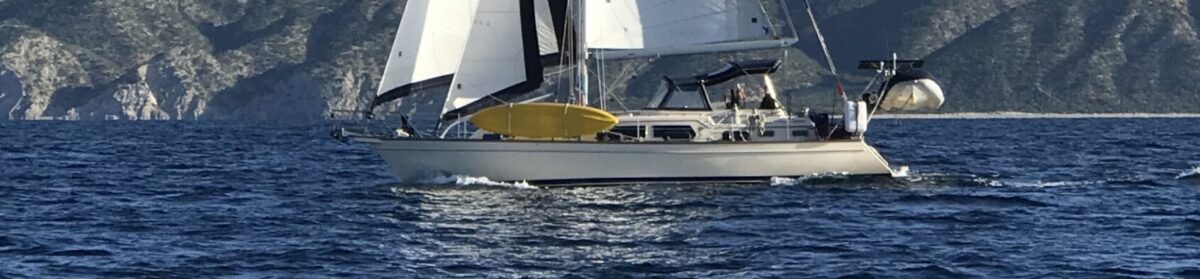
I think we will shift our normal wake up time to 7:30 instead of 7. It seems to be easier to get out of bed after the sun is up, or at least close. (Sunrise this morning was 7:53). We watched the movie “Cliffhanger” from 1993. It was ok, but I really don’t like heights and a bunch of this movie involved heights. Listened to the net, and did our bible reading.
Today we don’t have anything specifically planned. So, perhaps we will do some cleaning or putting away of things. Or maybe go for a walk?
Well as of noon, we have searched for the porthole knob (we have the tool to replace it and we bought three of them, even though we only need 1) so far no luck. Cano came and looked at our keel coolers for the refrigeration both are clean, and worked on clearing the hose for the aft AC unit. The hose is clear, but the AC heat exchanger is plugged.
Off to the pool for happy hour. While there we met a lady by the name of Jodi, we invited her to church with us in the morning. Then back to the boat, played a game of Rummy 500, then showers and bed.
We got up a bit late and barely made it to listen to the net. Then after breakfast we read the Bible and then talked about what we were doing for the day. One concern was when we would see the guy about the solar panels and controller. That was about the time that he called and we coordinated him coming over after lunch. We got ready and went to the pool for aqua aerobics.
While at the pool, we talked with the other cruisers about getting a part for the AC unit. One of the people there will be in Los Angeles next week. So, when we got back the to the boat I started into ordering the part.
Brian (for the solar panels) arrived and we discussed the sale. Renee’ got a ride to Walmart and got groceries. By the end of the day, we have an agreed price on the equipment and the groceries were put away.
After an early dinner, we went to the pool for happy hour. Then back to the boat.
Reneé checked her email and we found out our insurance broker needs to know what we did to increase the value of our boat if we want to insure it for more than we paid for it. We had a survey done for the insurance last season, and part of the survey is an estimation by the surveyor of what the boat is worth. His appraisal of the boat was about 50% higher than we paid for it. We are asking for our insurance to cover 25% more than we paid for it, so we have to justify this increase. Part of the increase in value is because the boating market is high right now, and we have really taken care of our boat fixing everything we can as we find issues. As a result he rated our boat as “Bristol”. The survey from when we bought the boat did not give it an overall condition, what they said was all systems were in “Good or Satisfactory Condition”. This list is what I found on the internet to explain the ranking.
“Excellent (Bristol) Condition” is a vessel that is maintained in mint or Bristol fashion – usually better that factory new – loaded with extras – a rarity.
“Above Average Condition” has had above average care and is equipped with extra electrical and electronic gear.
“Average Condition” is ready for sale requiring no additional work and normally equipped for her size.
“Fair Condition” requires usual maintenance to prepare for sale.
“Poor Condition” substantial yard work is required and devoid of extras.
“Restorable Condition” enough of the hull and engine exists to restore the boat to useable condition.
At this point we are only giving them the list of what we did, if they ask we will make the effort and figure out how much all of this cost.
Here is the list we came up with:
Standing rigging replaced (2019)
Running rigging replaced (2021)
Main, Jib and Staysail replaced with North Sails 3Di (2021)
Preventers for mainsail run from cockpit with stops to end of boom (2019)
Canopy, bow to stern with one side screen for shade.(2021)
Covers for toe rail and “eyebrow” (2021)
Cockpit cushions (12/2020)
Replaced windows in Dodger with Strataglass (2022)
Stainless steel tubes welded life lines. (2020)
Stainless Fender racks 3 port and stbd forward (2020)
4 Stainless jerrycan racks aft port,(2 diesel , 2 gas) all jerrycans in sunbrella bags. (2020)
Stainless Propane tank rack aft stbd tank in sunbrella bag.(2020)
10 foot dinghy with chaps and cover (2022)
20 horse power Suzuki (97 lbs), (2019)
1,100 watts of solar (2022)
Victron Energy multi plus charger/inverter (12/2020)
600 ah LiFePO4 Battleborn, 6 batteries) (new 12/2020)
SiriusXM antenna (2019)
Iridium GO! (2019)
Cell amplifier, with antenna at top of mast (2019)
Water maker 20 GPH. AC powered, (new June 2019) upgraded to 33GPH (2021)
Life raft Rescyou Pro 6 person (2019, recertification 2022)
Then we watched a movie and went to bed. Another day on the boat.
Up early (6:30) we had to get the dinghy prepped for the chaps and cover. Ivete from “A stitch in time”) is due at 8 am to start work on it. We had our breakfast and we were on deck with the dinghy down by 8 am. Then spent the next hour or so going over the stuff that Ivete needed, finally deflating the dinghy and getting it up to her truck to go away for a couple of weeks.
Gareth Clark the refrigeration/AC guy got to the boat about 10:30 or so, and started in to the refrigerator and then the aft . AC unit.
Reneé headed off to the store. She has to get something for the potluck tonight.
By the end of the day, we now know that the fridge has a small freon leak. It has been recharged and is working much better. The Aft AC unit has a bad thermal switch, and all three AC units need to be cleaned (water side). This will require Gareth to return with chemicals, hoses and pumps for this job. The thermal switch is available in the states for a $1.55 price from a salvage company, or $33 new. In both cases plus shipping, I will call the surplus company about shipping to Mexico tomorrow.
Reneé is back from shopping, and we will head off to the pot luck around 5:45.
We had a good time at potluck and rekindled the relationships we had started at the end of last season. Then back to the boat relaxing and bed.
This is the new vent cover installed over the fan that cools the solar charge controllers. Only one part left to do on this project, install the temperature controller.At the pot luck.This is one of guests at the pot luck. Look at the next picture for a close up.Close up of the guest at the pot luck
We flew back to Puerto Vallarta yesterday. A pretty quiet flight, no delays, no issues. Once back on the boat we put some stuff away and figured out what we forgot or lost in transit. We brought two large duffle bags and a big suitcase each weighed between 49 and 49.5 pounds. We also had two backpacks, and a computer bag. But, a bag of kidney beans is missing, and I forgot to order an XM antenna for the stereo. The reason we brought the kidney beans is that there are somethings we can’t find in Mexico. Oh well, we will keep looking and see if we did bring them somewhere.
After we got back on the boat, I started contacting people to work on our boat. That was a bit difficult as I could not find the note on who was coming to work on the generator. After going through the process, I was finally able to figure out how to identify this person. I had John Pounder do the wiring for the new solar panels, and he had two guys help him, one of them had a friend/neighbor/relative who is the person who worked on the generator, name of Marce), but I had only John’s contact information. It took about 3 hours to get the name of the guy who helped John, Oscar, who said he would contact Marce and pass on our contact info.
We got up slowly this morning, Reneé had a headache, and I had set the alarm for 7 am, but the sun didn’t get up until 7:54. So, I rolled over and went back to sleep. Eventually, I got up and turned on the VHF to listen to the morning net at 8:30. Somewhere in there Reneé got up and after breakfast and our bible reading, we started putting clothes away. We had vacuum packed a bunch of stuff to keep it from getting wet.
On the net this morning, I listed the solar panels and controller for sale. I have one person that is asking for more information, so we will see what happens. We will see Friday morning.
In the afternoon, we went to the pool and met up with a bunch of other cruisers. Drank some beer and committed to joining in the pot luck tomorrow night!
Back to the boat, showers and bed.
As of June 20, 2022 the new solar panels and controllers are installed. I forgot to get pictures of the breakers between the charge controllers and the batteries and the charge controllers and the breakers between the panels and the charge controllers. I will update this when I have those pictures.
We have finally completed our solar upgrade. Some background:
We had 470 watts of solar panels on the boat when we bought it, this was two panels at 235 watts each that fed an Outback FlexMax 60 controller. This provided a maximum of about 20 – 25 amps depending on the angle to the sun and how much cloud cover there was.
Our boat has significant loads on the battery system. We have a freezer, a refrigerator, and a beverage cooler. There are other things that run on our boat like fans and lights etc.
Typically overnight we use about 30% of our battery bank, 600 ah (amp hours). Or about 200 ah used overnight. Then with our old solar we would gain back about 10% of our battery bank capacity during the day.So, we start at 100%, at the end of the day, in the morning we are down to about 70%, by the end of the next day we are at about 80%, then in the morning 50%, by the end of that day up to 60% etc. This all assumes we don’t run the engine or generator to help anywhere along the way.
Our new system is 1,100 watts of solar panels with each panel going to a separate controller. 1100/470=2.34. We have about 2 1/3 times as much power coming in now. We were getting 10%. So, at the very least we should get 23.4%.
Really, though, let’s take another look at this. 470 watts was sufficient to run the loads during the daylight hours that overnight used 200 ah, AND put another 10% back in. So, we should get 10% from the first 470 watts, and 10% from the next 470 watts (and also the amount of power that is used by the refrigeration etc. 200 ah/10 hours approximately) and we still have about a third again as much power. What I am expecting is 60ah (10%) + 260 ah (the second 470 watts) + 88 ah (the 1/3 of what the second 470 watts is making) for a total of around 408 ah. Of course the reality is that once the battery bank is full we won’t see any more power from the solar panels. So, if we use 300 ah overnight, we can only put 300 ah back in. Then we are fully charged.
So, what did we do? We looked at the arch and said how big of a solar array can I put up there. At this point I am aware that the panels will not be aligned optimally because they are in a fixed arrangement. What we got out of the old panels is about 66% of what they are rated at. One of our sons has a solar system on the roof of his RV and he also has them in a fixed arrangement. He sees about 66% of rated output. We both have made sure that there is minimal shading for our systems. I have done a bunch of reading on this, and if you can’t adjust the panel angle to the sun, you will get something less than optimal output. As you have heard me say (I am sure) EVERYTHING IS A COMPROMISE. Advantage of having the angle moveable would be more output from the panels. Disadvantage is that the parts that would make it moveable would be exposed to salt air and water, which means corrosion. It would also be weaker and this is a pretty big flat surface for the wind to work on. On top of that, it is important that the panels are aligned correctly to the sun as well. Which is something I will have little to no control over anyway. When the boat is moving, we are not going just anywhere we are going from point A to point B, and probably won’t be going directly away from or towards the sun. When we are at anchor, the boat typically will face into the wind/current, which may or may not have anything to do with where the sun is. I believe it is better to work with averages at this point and assign a fairly low efficiency rating (like 66%) to the rated output. Some days we may see more, somedays less. But it gives us a place to start.
We started with what we had, two panels rated at 235 watts each mounted on the arch. Also on the arch were 6 antenna’s and the wire for a seventh. Those were:
3 GPS antennas.
1 for the VHF radio (marine radio line of sight)
1 for the AIS radio (marine Automatic Identification System – required for large ships, optional for sailboats, nice to have)
1 for the SSB radio (short wave, beyond line of sight)
1 AIS transceiver antenna
1 SiriusXM antenna (radio without commercials)
1 Iridium antenna (satellite communications)
1 Satellite TV (the antenna was going but the wire was still in the arch
2 lights, one is a stern light for navigation, the other is a flood light to help get the dinghy aboard at night.
2 stereo speakers for listening to the radio
2 Solar panels
That is a total of 13 sets of wires that had to come out of the arch before the grinding/welding could be done for the supports for the new panels. Some of the wires had to be removed from the back of the radio and pulled out to the antenna, some from the bottom of the antenna back to the radio, or in the case of the lights/solar panels/stereo speakers, just into the aft lazarette under the arch. This alone took 3 days, the first day the electrician worked by himself, the second day he had a helper, the third day there were 3 of them working. The reason all the wires had to be removed was proven later.
Then the welders showed up and took the old panels down and ground off the supports for them. Once they were off, the arch was ground smooth and polished so that it looked like they had never been there. This took about two days. Then over the course of about a week the new supports were fabricated and welded into place for the new panels. All of the welds were ground smooth and polished again. We chose to use 316 stainless steel rather than 304 stainless steel. The difference is the 304 is stronger, but not as likely to not rust as the 316, oh and by the way it is about twice the cost.The welder we chose was one of the three bids we got, and a point in his favor was when he showed up and identified the ladders on our boat saying that he made those. His bid was not the highest or the lowest, for the 304, and it was the only one that bid on the 316 version.
One thing that we had asked to get fixed along with all of this was the swim ladder that had broken off a bolt on the side of the ladder. This was a bit of a pain, the ladder is a “must have” to get back on the boat if you are swimming off the back end of the boat. Without the bolt/nut that was broken, there was really not an issue as the part that was broken was past where it supported the weight of the ladder and person on it. But, it had a sharp edge (I got a scrape from it in January and did not draw very much blood, but you can still see the mark in July). This was also fixed while they worked on the arch.
Finally all the welding/grinding was done for about $2,500.
Now about the panels, the old panels were physically 65.4” x 39” the new panels were quite a bit larger, 90” x 45”. I did a bunch of searching on the internet and found that the panels I wanted were 670 watts each, but they are brand new and everywhere I turned I found that the only way I could get them is if I ordered a LOT, as in 100,000 panels. Well that was out.
So, I looked at smaller panels that would fit between the antenna’s on the arch and had decided to go with 3 panels at about 450 watts each that would just fit between the antenna (barely) this would have been 1350 and they would have been 75” x 45” and would have required moving 4 antenna mounts out to the edges of the arch.
A compromise was the two panels at 550 watts each. They fit between the existing antenna mounts and were available that week and were delivered to the boat for about $350 each. The two controllers were another $500 each.
The controllers I selected were Victron Energy 100/50 smart controllers, these interface with the Cerbo GX which is the control display interface for the charger/inverter that we have already got.
Now that the panels were installed it was time to do the wiring, this was a couple of WEEKS of the three guys pulling wires and hooking stuff up. While doing this, some of the rope that had been left in the arch from before for pulling wire (which was made of nylon) melted inside the arch and was difficult to remove. If it any wire would have been left inside the arch it might have been welded to the inside of the pipe. In any case they got all the wires run and hooked back up and the controllers set up. We put the controllers inside the chart locker, which we don’t use anyway. I had a wood guy cut a hole for a fan and we have a 12 volt fan to keep the controllers cool as well.
Cost for the electrical work was bout $4,500.
Total cost of the project about $8,500. This is a huge upgrade to the boat.
In December 2020, we replaced our batteries with Lithium batteries and to make them last longer we don’t charge to 100% during the summer when we are off the boat. It is still somewhat uncomfortable for me to walk away from the boat, knowing that if we screw up the batteries by letting them go dead or overcharging them, we will have to replace them at about $6,000. So, it helps that the new setup is all visible and controllable via the internet. I have everything set and holding the batteries at about 73% charged.
This is what I saw from the internet while sitting in Missouri while writing this post.One of the old panelsOne of the new panelsThe other new panelsLooking down on the old panelsThe left side of the old panels, note the distance to the antennas to the leftThe right side of the old panels note the distance to the antennasThe right side of the new panelsThe left side of the new panelsThe new panelsThe new panelsThe new panelsThe old charge controller